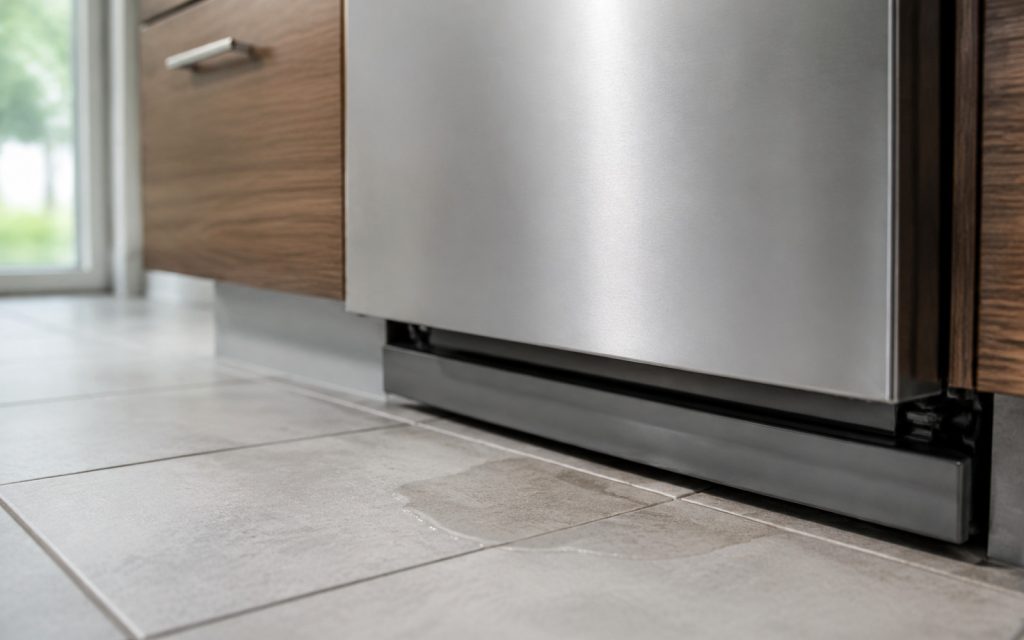
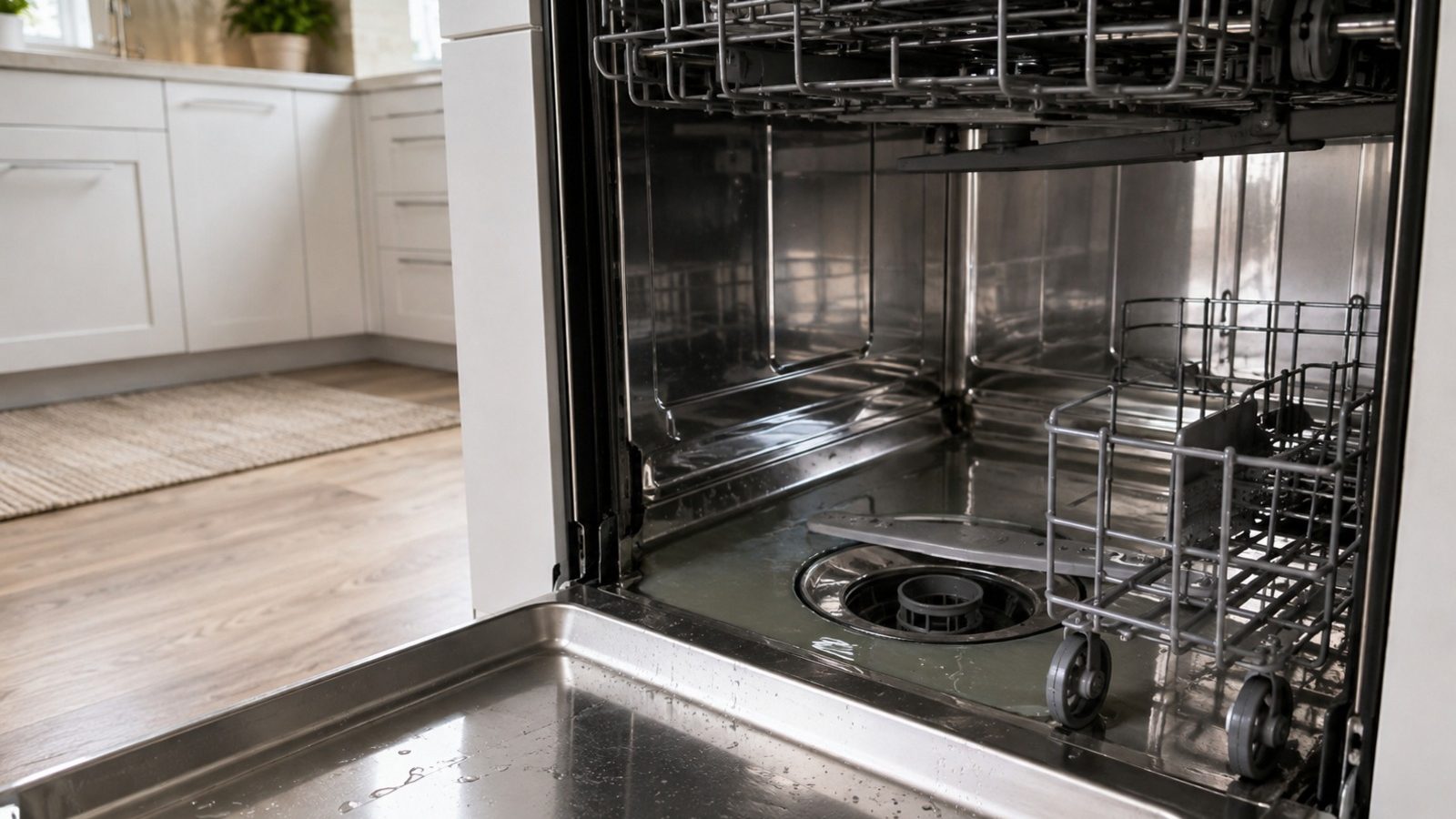

Standing water after a cycle usually points to a drainage restriction. Here is what you can safely check.
A dishwasher that is not draining often has a simple blockage: debris in the filter, a kinked drain hose, or a disposer connection that was never opened. Cancel the cycle, clean the filter as the manual describes, and look at the visible hose. If water remains after that, or a drain code appears, book a visit.
Water left standing in a dishwasher disrupts the day in a hurry. One symptom cannot tell you which part has failed, so gather observations you can make safely and repeat, which also help if a repair visit follows.
Owner-level care ends where testing or dismantling begins. Leave locks, safety switches and displayed errors in force instead of overriding them for one more run. A short set of notes made now gives a technician something concrete to work from later.
Cancel the cycle if it is still running, give the tub a moment to settle, and use the manual to take out and rinse the filter you can reach. Leave the dishwasher in its normal position and do not force panels, fittings or controls. If a simple change alters the result, run one normal cycle before concluding anything.
A visible kink in the accessible drain hose, or a disposer connection that was installed recently, can account for a drainage complaint without any failed pump. Look for a pattern as well: does it happen every time, only with a particular load or setting, or after the machine has run for a while? That matters more than restarting it again and again. After a recent disposer installation, ask whether the dishwasher inlet plug was knocked out.
| What you see | Probable cause | Check you can make |
|---|---|---|
| Cycle ends with water in the tub | Residue clogging the filter | Rinse it under running water |
| Sluggish drain | Kinked hose | Examine the hose where it is visible |
| Drain error shown | A restriction or a pump fault | Record the code |
A dishwasher pumps water out through a drain hose that usually connects to a disposer or sink drain. On many models the hose needs a high loop or air gap to prevent backflow, and a kink, a sag, or a clog at the disposer or tailpiece can hold water in the tub. For a new built-in unit, KitchenAid guidance notes that a knockout plug left in the disposer inlet blocks drainage completely.
The filter is the other early check. KitchenAid says to look for large objects such as toothpicks, broken glass, or olive pits in the filter area first and remove them by hand, and never to run the machine without the filters installed. A sewage-like smell can point to a clog or a kinked or sagging drain hose.
Look to the use-and-care manual for whatever is specific to your unit: control functions, filter access and maintenance schedules. Touch only the parts it lists as owner-serviceable, choose the cleaning products it suggests, and seat each removable piece the way it was designed.
First take out anything blocking the way, ease off an extra-heavy load, and check that air, water and door clearance are all free. Pressing reset over and over can cover up a fault that only appears now and then, and it could strand water, heat or pressure somewhere unsuitable.
Fine to attempt
For a technician only
Water that stays only after certain loads suggests debris. Water after every cycle, with a clean filter and a clear hose, points toward the pump or drain path, which needs testing. Some models display a drain-related code; the meaning and any reset step in your manual are the authority, and a code that returns after a reset points to a physical cause.
Reaching into the pump area, disconnecting wiring, or forcing repeated drain cycles can make a fault worse. Stay with the external items: the filter, the visible hose routing, and the disposer connection if it is new.
If water remains after cleaning the filter and checking the visible hose, or a drain code appears, book a visit.
No change after the basic checks means it is time to stop. Anything involving refrigerant lines, gas connections, control boards, motors, pumps, wiring inside the cabinet or heating circuits needs test equipment and a technician able to check that the repair is safe.
Call for service without delay if a breaker trips, if water leaks near electrical parts, or if there is a burnt or overheated smell. The same goes for worsening performance, a fresh grinding noise, or a failure to complete a normal cycle. Do not operate an appliance that shows a safety warning.
Useful details include the model number, what exactly goes wrong, the moment it began, the settings chosen, and the outcome of each safe check listed earlier. A snapshot of a code or a brief note on a sound can help as well, though never by removing a cover.
Noticing details is no stand-in for a repair, though it is the best opening move. Take care of the simple conditions, save whatever error information appears, and pass electrical, gas, sealed-system and internal mechanical tasks to a qualified appliance technician.
A clogged filter, a kinked drain hose, or a blocked disposer connection are the first things to check. If they are clear, the pump or drain path needs testing.
A new disposer with a knockout plug left in the dishwasher inlet blocks drainage completely, according to KitchenAid guidance. A clog at the disposer connection can do the same.
Once after cleaning the filter is reasonable. Repeated attempts can hide a fault, so book a visit if the water is still there.
Need help now? Visit our services page or contact us.
Official manuals and support notes are available on KitchenAid owner support.
The full model number should be recorded ahead of any parts order, since a revised board or sensor may call for a different part number.
Cycling the power once can wipe out a short-lived fault; a code that reappears each time usually signals something physical left unresolved.
Keep air paths and filters free of buildup in the time between visits; a restriction can produce symptoms that resemble a sensor or electrical failure.
Should water, a burnt smell or sparks appear, switch the appliance off and have a professional look at it before using it again.
Cancel the cycle if needed, allow the tub to settle, and follow the manual to remove and rinse the accessible filter.
Only if there is no burning smell, smoke, sparking, gas odor, water near electricity, or other safety warning. Otherwise stop and arrange service.
A tumbling drum with no heat may still be an airflow or setting issue — verify…
Door leaks often trace to detergent, loading, or gasket condition before any pump or tub repair.
Front leaks on a KitchenAid washer often involve the door gasket, dispenser, or drain path —…
Share a few details and we’ll confirm an appointment. Prefer to talk? Call us and we’ll help right away.
Fields marked with * are required.