
Flame color and shape changes on gas cooktops can signal cleaning needs or a supply issue worth professional review.
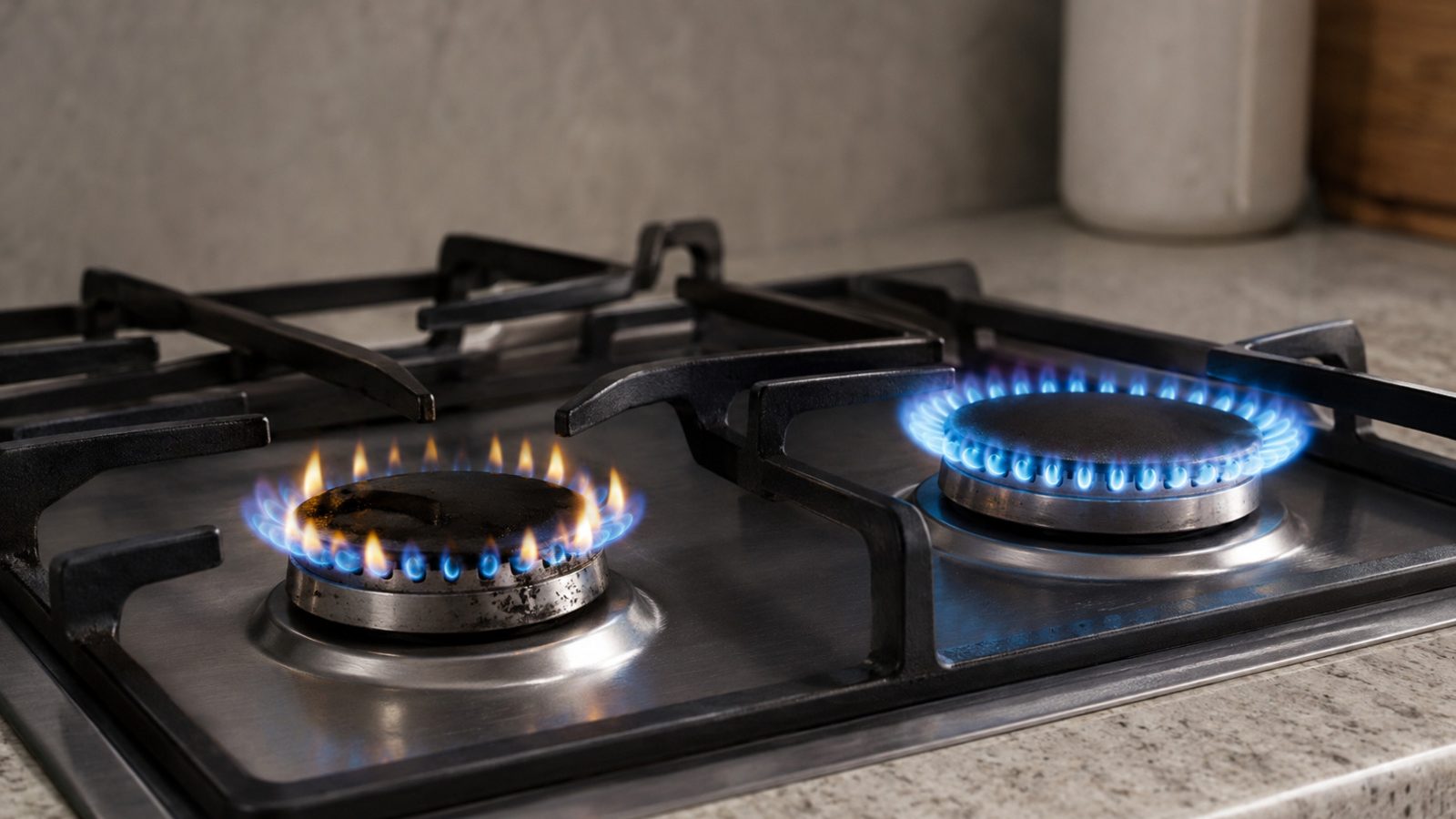
Uneven or yellow flames on a gas cooktop usually trace back to the burner itself: ports partly blocked by residue, a cap that is not seated flat, or conditions around the burner such as fuel type and venting. Let the burner cool, clean and reseat the cap, then compare the flame with a neighboring burner. If one burner stays yellow, noisy or lopsided, or every burner looks wrong, stop and book a diagnosis.
Ragged or yellow flames at a KitchenAid gas cooktop can disturb everyday cooking. What the flame looks like does not name a failed part, so start by gathering observations that are safe and repeatable, which also help if you later book a repair visit.
Some tasks are plain household care and others need test tools or disassembly, and this section keeps the two separate. Bypassing a lock, safety switch or error message to keep the appliance in use is off the table. Writing down your observations now shortens the diagnosis and improves its accuracy.
Make sure the burner caps sit straight, any visible ports are clean and dry, and the control is turned to the ignite position the manual recommends. Do the checking with the cooktop in its regular state and avoid forcing panels, fittings or controls. If a simple adjustment changes the outcome, light the burner once more under normal use before drawing a conclusion.
Dried sugar, starchy spills or cleaner residue can partly plug the ports and give one zone a weak or yellow flame. Check how it behaves: every time, only with a certain pan or setting, or after the burner has been lit for a while. That is more useful than relighting it repeatedly. Soot on the bottom of a pan, or a flame that lifts off the burner, describes the problem better than saying it just looks wrong.
| Flame appearance | Likely cause | Safe check |
|---|---|---|
| Yellow tips | Port restriction | Clean ports |
| One side weak | Cap misalignment | Reseat cap |
| All burners weak | Supply issue | Check other gas appliances |
KitchenAid support guidance for gas cooktops describes a soft blue flame on natural gas, and on LP gas a blue flame with slightly yellow tips can be part of normal operation on some models. A little yellow at the tips is therefore not proof of a fault by itself, while a flame that is mostly yellow, flickering or leaving soot on cookware deserves attention.
The same guidance lists a clogged port and a misaligned burner cap as the first suspects. Both can be checked from above with the burner cool. Improper conversion between natural gas and LP is also named as a cause of yellow flames, and that is a job for a technician, not a knob or screw you adjust at home.
Look up controls, filter access and maintenance intervals for your model in the use-and-care manual. Parts described there as user-serviceable are the only ones to clean, and the recommended products are the only ones to use; each removable part must go back exactly as designed.
Before the next cycle, free up anything that is blocked, ease off a load that is heavier than normal, and confirm airflow, water supply and door clearance are not limited. Avoid a string of resets; they can bury an intermittent fault and may leave water, heat or pressure behind.
Safe to try
Leave to a technician
Some range models draw air past the burners with a downdraft vent, and KitchenAid guidance notes that the vent can disturb flame stability. Try the burner with the vent off to see whether the shape changes, and keep other airflow such as a nearby fan from blowing across the flame.
When clearing a clogged port, support guidance points to a straight pin or needle rather than a wooden toothpick, and burner parts are not meant for the dishwasher. After washing, let every part dry fully before you light the burner, because a damp cap can give a weak, uneven flame that looks like a hardware problem.
When the basic checks change nothing, or one burner stays yellow, noisy or lopsided, stop and book. Gas connections and internal parts are not owner work.
A flame that stays uneven or yellow after the simple checks is where owner-level work stops. Gas connections, refrigerant lines, internal wiring, control boards and heating circuits need proper test equipment and a technician able to verify that the repair is safe.
Get service scheduled soon if the appliance performs worse over time, trips a breaker, leaks near electrical parts, gives off a hot or burnt smell, begins grinding, or cannot complete its normal cycle. If it displays a safety warning, stop operating it.
Give the model number first, followed by the exact symptom, its start, the chosen settings and the results of your safe checks. A picture of a code or a quick description of a noise is a bonus, but a cover must stay on while you gather it.
No amount of observation replaces repair work, yet it is the sensible opening move. Take on the simple conditions, record any error details worth keeping, and rely on a qualified technician for electrical, gas, sealed-system and internal mechanical tasks.
Color alone does not tell you. If a yellow flame goes away after you clean the ports and reseat the cap, it was likely a local blockage. If cookware turns black with soot, the flame stays mostly yellow, or you smell gas, turn the burners off and book a diagnosis; for a gas smell, leave the area and contact your gas utility.
A single weak burner points to something local to that burner, such as spilled food in the ports or a cap that is not sitting level. Comparing it with its neighbor, with the same fuel and the same cap style, is a useful and safe test.
Check the use-and-care manual for your model, but conversion is generally a technician task. KitchenAid support guidance lists an improper conversion among the causes of yellow flames, so a flame that changed after a move or conversion should be inspected.
Need help now? Visit our services page or contact us.
Official manuals and support notes are available on KitchenAid owner support.
Get the entire model number on paper before a parts order, as board and sensor revisions can change the part that is correct.
Try one power reset at most; it can clear a temporary fault, yet a repeat of the same code usually means a physical cause remains.
Keeping filters and vents free of blockage between visits matters because poor airflow can resemble an electrical or sensor fault.
Shut the appliance down and arrange professional inspection if water, a burning smell or sparks are present.
Confirm burner caps are aligned, visible ports are clean and dry, and the control is set to the recommended ignite position.
Only if there is no burning smell, smoke, sparking, gas odor, water near electricity, or other safety warning. Otherwise stop and arrange service.
Large cavities and hidden elements can make preheat feel slow — learn what is normal and…
Musty or food smells usually come from filters, standing water, or loading habits — not a…
Frost layers often point to airflow, door closure, or defrost issues — not always a failed…
Share a few details and we’ll confirm an appointment. Prefer to talk? Call us and we’ll help right away.
Fields marked with * are required.