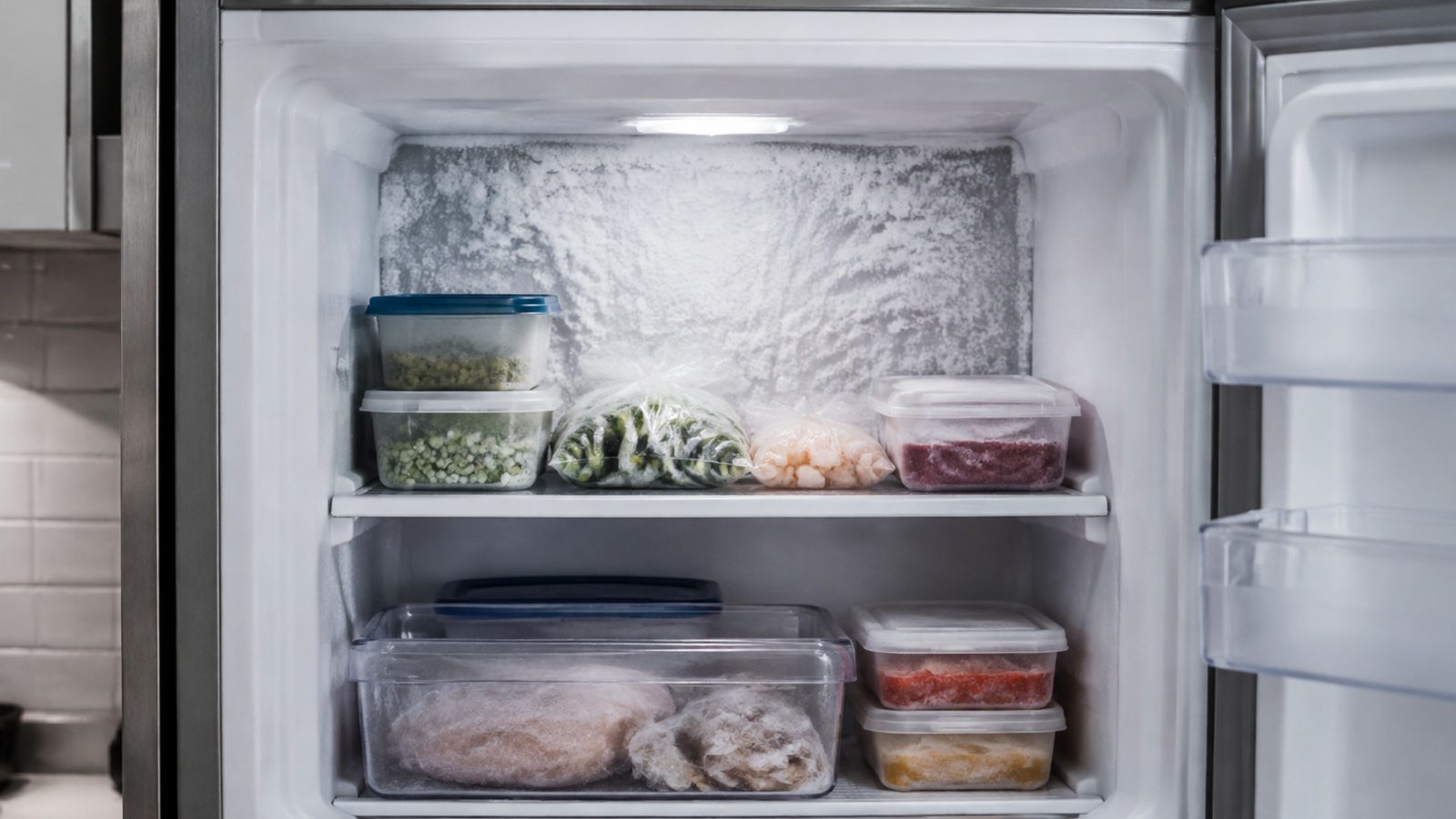

Frost layers often point to airflow, door closure, or defrost issues — not always a failed compressor.
Heavy freezer frost usually comes from moist air getting in, through a door that does not close fully, a worn gasket, or packages blocking the vents. Clear the vents, check the seal along its full length, and avoid holding the door open. If frost returns quickly after a defrost, the defrost system may be involved and the freezer needs diagnosis.
A thick coat of frost in a KitchenAid freezer compartment makes everyday use awkward. The symptom cannot name a faulty part by itself, so open with observations that are safe, easy to repeat and helpful if you later arrange a repair visit.
Everyday care is one matter and work requiring testing or disassembly is another. Never defeat a control lock, a cutout or a displayed fault to keep the appliance running. Taking notes now can speed up the diagnosis and make it more accurate.
See that food is not covering the vents, the gasket seals along its whole length, and nobody holds the door open while loading. Keep the unit in its usual position and force no panel, fitting or control. If a tweak improves things, give it a normal day of use before concluding. A paper held in the door at several spots along the seal shows where the gasket fails to grip.
Moist air coming in through a gap in the gasket, or an item that stops the door closing fully, can build frost faster than the defrost cycle clears it. Look for a pattern: constant, tied to certain loads, or only after the freezer has been busy. That is more useful than switching the freezer off and on repeatedly.
| Symptom | Likely cause | Safe check |
|---|---|---|
| Frost on packages | Door gap | Inspect gasket |
| Ice on rear panel | Airflow block | Clear vents |
| Returns quickly | Defrost issue | Book diagnosis |
KitchenAid freezer guidance describes a thin, even layer or a light dusting near the vents as normal. Heavy, uneven buildup, especially over food packages or on the back wall, is not.
The same guidance lists the usual causes of frost as warm, moist air from a door left ajar, a damaged gasket and an overstuffed freezer. Packed shelves can also block airflow, so loosen the load before judging the freezer.
The use-and-care manual spells out controls, access to parts and care intervals for your model. Clean only parts it describes as user-serviceable, follow its cleaner recommendations, and set each removable piece back exactly where it belongs.
Ahead of another test, clear whatever is in the way, ease up on an overloaded freezer and make sure airflow and door clearance are free. Frequent resets are a poor idea, since they can hide an intermittent fault and leave moisture or pressure where it does not belong.
Safe to try
Leave to a technician
On a manual-defrost freezer, KitchenAid’s instructions are to unplug it, remove the food, set a pan of hot water inside and scrape gently without stabbing. Do not use mechanical devices to speed up defrosting.
Auto-defrost models make sizzling or gurgling sounds during defrost, which the use-and-care guide describes as expected. After a defrost, watch how long it takes for frost to return: slow return suggests a door or load habit, while fast return suggests a defrost fault.
If frost returns quickly after a defrost, the defrost system may be involved and the freezer needs diagnosis.
If the basic checks do not alter the symptom, stop at the edge of owner-level work. Internal wiring, defrost heaters, motors, refrigerant lines and control boards call for proper instruments and a technician trained to verify the repair.
Seek service without waiting if frost is building faster, the breaker trips, water collects near electrical parts, a scorched or hot odor appears, a new grinding noise starts, or the freezer cannot hold its normal operation. A unit that shows a safety warning should be left off.
Share your model number, what exactly happens, when it began, the settings in use and the outcome of each check above. A picture of an on-screen code or a brief description of a noise is useful, though no panel should come off to get one.
Paying attention is not the same as repairing, but it is the strongest place to start. Deal with the simple conditions, keep any helpful error information, and pass electrical, sealed-system and deeper mechanical jobs to a qualified appliance technician.
Yes. A thin even layer or a light dusting near the vents is described as normal. Frost that thickens over packages, or ice that blocks vents, is a sign to check the door seal and the load.
No. KitchenAid says not to stab at ice or use mechanical devices. Let a manual-defrost freezer thaw with a pan of hot water as its instructions describe.
If the door seals, the load and the vents are all fine, a quick return can point to a defrost problem. That calls for testing, because it involves the freezer’s internal components.
Need help now? Visit our services page or contact us.
Official manuals and support notes are available on KitchenAid owner support.
Write the whole model number down prior to ordering parts, as board and sensor revisions may change which part number is correct.
A lone power reset might clear a short-lived fault; if the same code returns again and again, expect a physical cause.
Keep the freezer’s vents and filters free of obstruction between visits, since poor airflow often resembles an electrical or sensor fault.
If water, a burning smell or sparking turns up, stop using the freezer and arrange a professional inspection.
Check that food is not blocking vents, the door gasket seals along its full length, and the door is not being held open during loading.
Only if there is no burning smell, smoke, sparking, gas odor, water near electricity, or other safety warning. Otherwise stop and arrange service.
Flame color and shape changes on gas cooktops can signal cleaning needs or a supply issue…
Large cavities and hidden elements can make preheat feel slow — learn what is normal and…
Musty or food smells usually come from filters, standing water, or loading habits — not a…
Share a few details and we’ll confirm an appointment. Prefer to talk? Call us and we’ll help right away.
Fields marked with * are required.