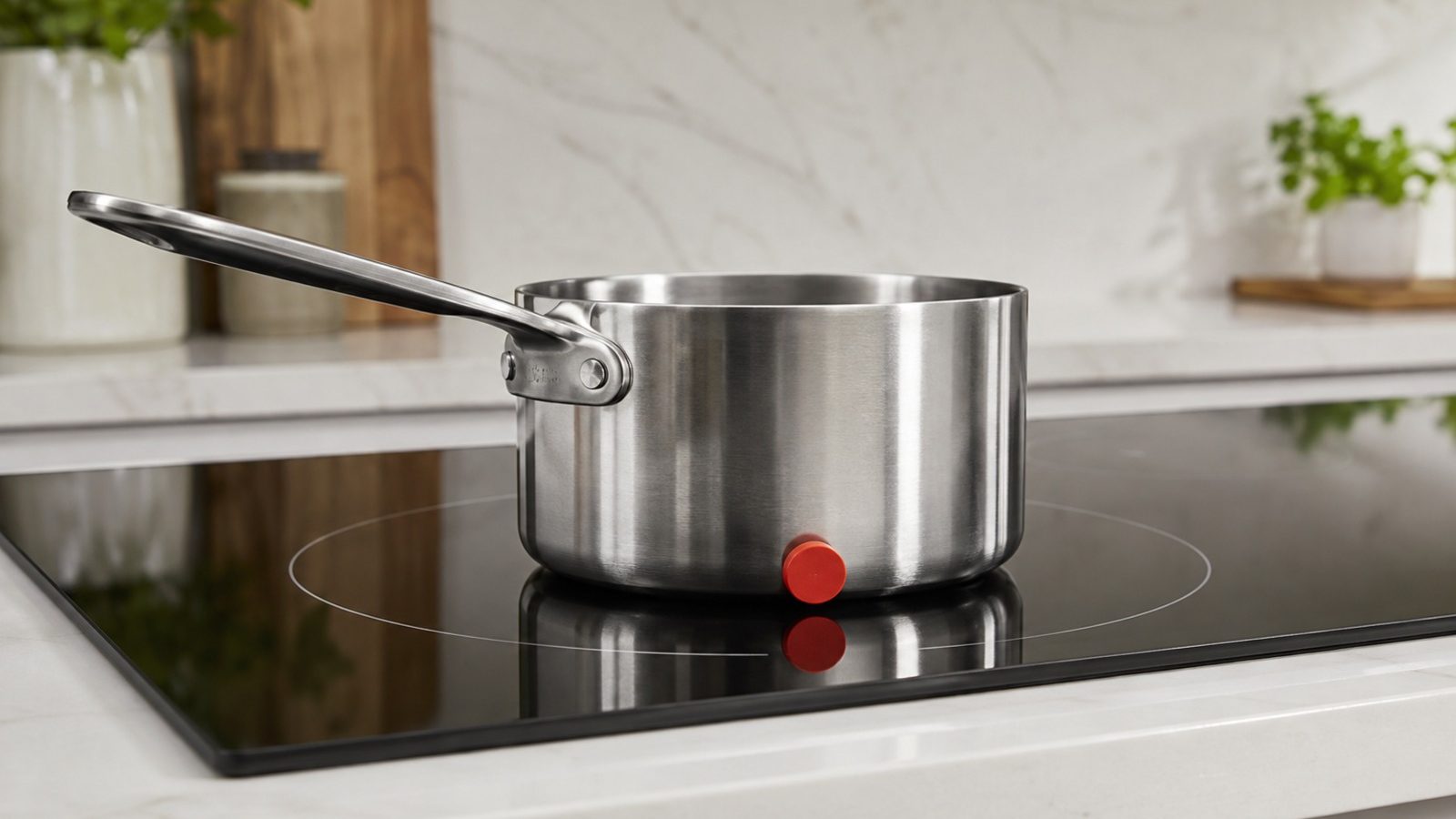

Compatible, correctly placed cookware is the first thing to verify when induction will not heat.
An induction cooktop only detects cookware with a magnetic base, so most no-detection cases come down to the pan: a nonmagnetic material, a base that is too small for the zone, or one that is warped. Try a magnet on the base, center the pan on the matching zone, and check the control lock. If a known good pan fails on every zone, book diagnosis.
A cooktop that ignores the pan on it throws off cooking for the whole household. A symptom by itself does not identify a faulty part, so start with observations that are safe, easy to repeat, and valuable if you later arrange a repair visit.
Cooktop upkeep is one thing; work that calls for testing or taking things apart is another. Do not defeat a control lock, a cutout or a displayed fault just to keep a zone heating. Jotting down notes now speeds the eventual diagnosis and sharpens it.
Hold a magnet to the pan base, set the pan in the middle of the matching zone, and compare its size with the zone guidance in the manual. Do this with the cooktop where it is, forcing nothing. If a small change fixes it, do one normal use before drawing a conclusion. A magnet that clings firmly to the base suggests the pan is compatible.
Induction heats magnetic cookware directly, so a nonmagnetic pan, a warped base, a very small pan or an active control lock can all pass for a cooktop fault. Try to spot a pattern: every time, only with one pan or setting, or only after some time in use. That detail beats switching the cooktop off and on again and again.
| Result | Likely cause | Safe check |
|---|---|---|
| Pan not detected | Base not magnetic | Try the magnet test |
| Zone cuts out | Pan undersized | Use a larger pan, centered |
| Every zone fails | Controls or power | Book a diagnosis |
Per KitchenAid’s cookware guidance, pans should be ferromagnetic: enameled steel, cast iron or induction-rated stainless steel. Glass, ceramic, copper and aluminum will not work by themselves, although some pans combine several layers.
The pan base should match the zone, and no more than a half inch smaller than the element. Manufacturers often list the top diameter instead of the base, so measure the flat bottom. A base that is only partly magnetic heats unevenly, while one that is mostly nonmagnetic may not be detected.
Look in the use-and-care manual for the controls, cleaning access and upkeep intervals that apply to your model. Wipe and clean only what it names as user-serviceable, choose the cleaners it suggests, and put back every removable item the way it was meant to sit.
Before the next try, remove anything in the way, lighten an unusually heavy pan load, and check that ventilation, power and clearance around the cooktop are not restricted. Resetting repeatedly is worth avoiding, as it can hide an intermittent fault and leave heat or power where it should not be.
Safe to try
Leave to a technician
Spilled liquid or soil on the touch controls can interfere with them, so wipe the surface and try again. The cooktop may lower a zone’s power level to avoid overheating, and poor ventilation around the cooktop can cause shutdowns and longer boil times.
Some models show a flashing indicator when no suitable pan is found. Check your manual for what your display means rather than guessing from another model.
If a known good pan fails to register on every zone, book a diagnosis. A single zone failing with one pan points back to the pan.
If the basic checks change nothing, stop where owner-level work ends. Wiring behind the glass, heating circuits, motors, refrigerant lines, gas connections and control boards demand proper instruments and a technician trained to verify the repair.
Get service arranged quickly when things are getting worse, a breaker trips, liquid leaks near electrical parts, something smells hot or burnt, a new grinding sound starts, or the cooktop cannot complete normal use. A unit that gives a safety warning should be left off.
Give the technician your model number, the symptom in exact terms, the date it began, the settings you used and what each check above showed. A photo of an error on the display helps, but never remove a cover to read one.
Paying attention to details does not replace repair, though it is a good opening step. Handle the basics, keep whatever error information appears, and pass electrical, gas, sealed-system and deeper mechanical work to a qualified appliance technician.
Not by themselves. KitchenAid says glass, ceramic, copper and aluminum will not work alone. A pan with a magnetic base layer can work.
The zone looks for a base of about the right size. If the base is more than a half inch smaller than the zone, it may not be detected. Measure the flat base, not the rim.
The cooktop can reduce a zone’s level to prevent overheating, and ventilation around it plays a role. If the cooktop shuts off repeatedly, book a diagnosis.
Need help now? Visit our services page or contact us.
Official manuals and support notes are available on KitchenAid owner support.
Note the full model number prior to buying parts, because board and sensor revisions can alter the correct part number.
Cutting power once can clear a short-lived fault; a code that keeps coming back generally means something physical remains.
Clear ventilation around the cooktop between visits matters, since blocked airflow often looks just like an electrical or sensor failure.
If you see water or sparking, or smell burning, stop using the cooktop and arrange for a professional to inspect it.
Test the pan base with a magnet, center it on the matching zone, and make sure its diameter meets the zone guidance in the manual.
Only if there is no burning smell, smoke, sparking, gas odor, water near electricity, or other safety warning. Otherwise stop and arrange service.
A tumbling drum with no heat may still be an airflow or setting issue — verify…
Door leaks often trace to detergent, loading, or gasket condition before any pump or tub repair.
Front leaks on a KitchenAid washer often involve the door gasket, dispenser, or drain path —…
Share a few details and we’ll confirm an appointment. Prefer to talk? Call us and we’ll help right away.
Fields marked with * are required.