
A clean filter supports good drainage and cleaning. Here is a safe routine.
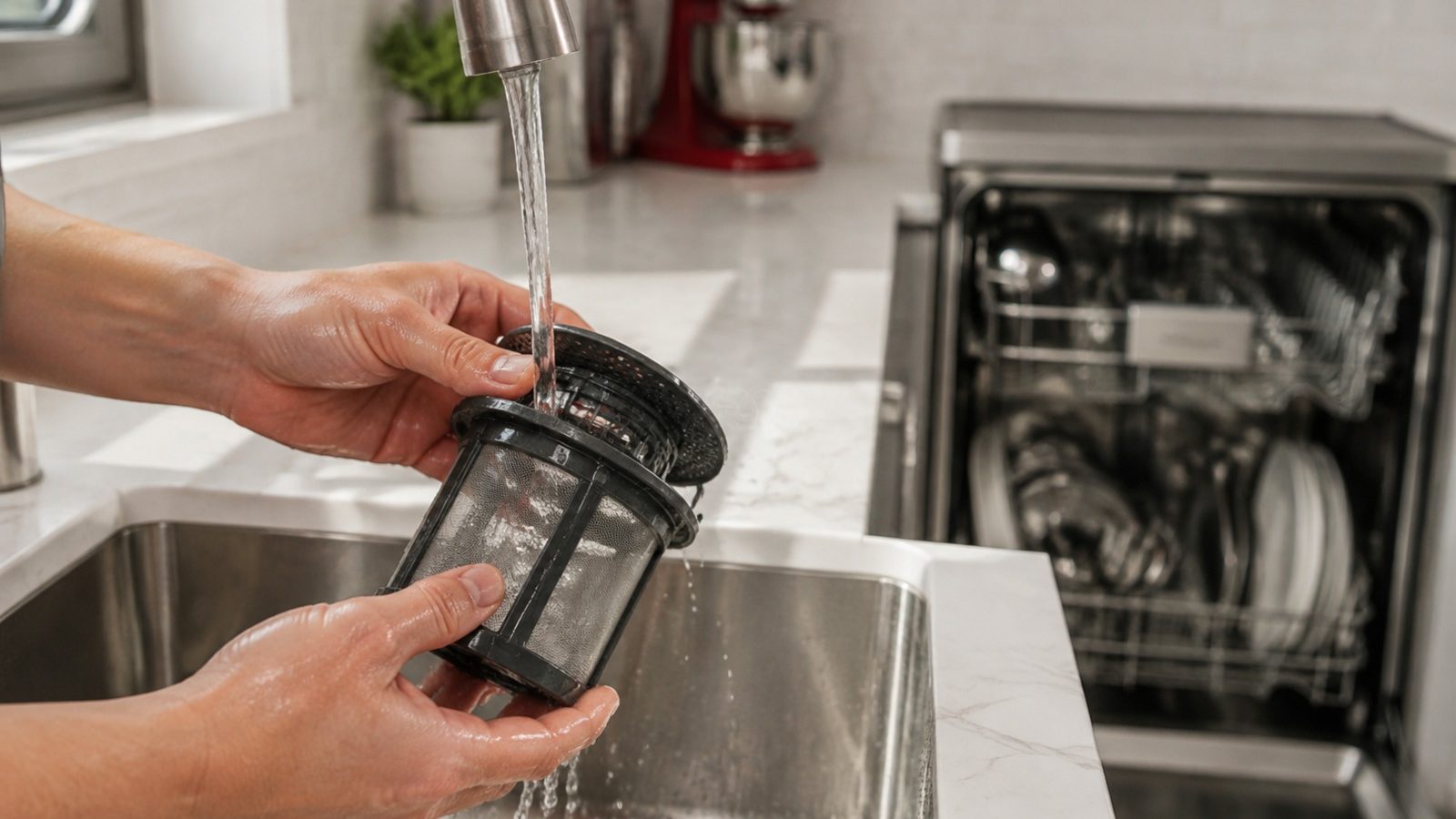
Clean a dishwasher filter by following your manual to remove it, rinsing it under running water, using a soft brush on any buildup, and refitting it until it locks. Never run the machine without the filters installed. If the water still will not drain or a clean filter keeps clogging, the cause is deeper than the filter.
Cloudy glasses or a grimy tub can make a filter look like the culprit, but what you see does not name the failing component. Gather observations first that are safe to make and easy to repeat, because they will also serve you if a technician is called afterward.
Plain rinsing and brushing belong to the owner; anything calling for test instruments or a dismantled machine does not. Do not override a latch, a safety interlock or a displayed message to push a cycle through. Short notes written today will make a later diagnosis quicker and more exact.
Let the dishwasher sit switched off until it has cooled, then locate the filter using the manual and turn and lift it out only the way the instructions show. Keep the machine where it stands, and never force panels, fittings or controls. If a small fix alters the outcome, run a regular cycle before you decide it worked.
Scraps lodged in the mesh or the housing around it can weaken cleaning and slow drainage, and this is likelier when dishes go in without a rinse. See whether the trouble recurs every time, shows only with certain loads or settings, or appears once the machine has been going a while, which says more than restarting it over and over. A very grimy filter is also a hint that your real gap between cleanings runs longer than the manual advises, so treat it as a cue to clean sooner next time.
| Task | How often | Method |
|---|---|---|
| Rinse the filter | Once a month | Warm running water |
| Remove stuck debris | When needed | Soft-bristled brush |
| Inspect the housing | At every cleaning | Gentle wipe |
KitchenAid describes two styles. One is a removable filtration system you rinse and clean. The other is a maintenance-free style with a foreign object cup below the lower rack, and on that style you only deal with the cup when it fills: press the center tab, pull up, empty it, and push it back until it locks. Look at the bottom of your tub to see which style you have before following any cleaning steps.
For the rinse-and-clean style, check the filter area for large objects first, such as toothpicks, broken glass, or olive pits, and remove them by hand with care. Then rinse the filter under running water. KitchenAid says not to use a wire brush or scouring pad, and a soft brush is the suggestion for hard-water calcium deposits.
The use-and-care manual lists the controls, the filter location and the care intervals that fit your model, so keep it close. Only handle parts it describes as owner-serviceable, stick to the cleaning products it suggests, and seat each removable piece back in its intended spot.
Prior to a fresh cycle, pull out whatever is blocking, ease off an overloaded rack, and make sure water can arrive, air can move and the door can swing without hindrance. Frequent resets are best avoided, as they may hide a fault that comes and goes and can leave water or pressure where it does not belong.
Owner-friendly steps
For a technician only
A filter that is clean but seated wrong does not work. KitchenAid notes that if the upper filter assembly turns freely, it is not locked, so turn it until it seats before closing the door. Running the dishwasher without the filters properly installed can damage it, which is why a quick test of the fit matters as much as the rinse.
The cleaning interval is also worth tracking. The guidance is to clean the dishwasher about every 30 days, and to run affresh Dishwasher Cleaner monthly to help prevent filming, spotting, and odors. Some models have a Clean Filter indicator: clean the filter, hold the Clean Filter button for 3 seconds, then open and close the door to reset it.
If water still will not drain, or a clean filter keeps clogging, the cause is deeper than the filter and needs a visit.
Once the simple steps fail to change anything, stay inside what an owner can safely handle. Inside wiring, heater circuits, pumps, motors, refrigerant lines, gas fittings and control boards need suitable test equipment and a technician who can confirm the work is safe.
Do not wait to book service if performance keeps sliding, a breaker trips, water shows up near electrical parts, a hot or burnt smell appears, a new grinding sound starts, or the machine cannot get through a normal cycle. A unit displaying a safety warning should stay off.
Tell the technician the model number, the exact problem and when it started, which settings you had chosen, and what the safe checks revealed. Photographing a displayed code or describing the noise is welcome, though taking off a cover to do so is never advisable.
Observation will not replace a repair, but it makes the strongest opening move. Handle the straightforward conditions, keep any helpful message you saw, and let a qualified technician take on anything involving electrical work, gas, the sealed system or internal moving parts.
KitchenAid’s guidance is to clean the dishwasher about every 30 days, and your manual may give a different schedule for your model. Homes that do not pre-rinse dishes may need to look at the filter more often.
No. KitchenAid advises against a wire brush or scouring pad and suggests a soft brush for hard-water calcium deposits.
On models with that indicator, the light is reset by holding the Clean Filter button for 3 seconds and then opening and closing the door. If it returns right away, check that the filter is seated and locked.
Need help now? Visit our services page or contact us.
Official manuals and support notes are available on KitchenAid owner support.
Before you order any part, record the whole model number, because revisions to boards and sensors can alter which part number fits.
Cycling the power once can wipe out a brief fault, yet the same code showing up repeatedly typically means a physical issue remains.
Keep filters and vents clear in the time between visits, since blocked airflow often looks like an electrical or sensor failure.
When there is water pooling, a scorched smell or any sparking, stop running the appliance and ask a professional to inspect it.
Wait until the dishwasher is off and cool, then use the manual to locate, twist, and lift the filter only as instructed.
Only if there is no burning smell, smoke, sparking, gas odor, water near electricity, or other safety warning. Otherwise stop and arrange service.
Clean venting improves drying performance and is an important home-safety habit.
Simple gasket, drawer, and drum care helps prevent musty odors in front-load washers.
Clear airflow and clean door seals help a refrigerator run efficiently.
Share a few details and we’ll confirm an appointment. Prefer to talk? Call us and we’ll help right away.
Fields marked with * are required.